
On this page
What can go wrong with gutters in Charlotte?
Queen City Gutter Co connects callers with independent local gutter contractors, who give the estimates and do the work. Repair calls in Charlotte tend to fall into a handful of patterns, most of them tied to the city's weather and its trees.
- Leaks at joints. Corners, end caps and outlets are sealed joints. Summer heat, winter freezes and standing debris break the seal. See leaking gutters.
- Sagging runs. Old spikes back out of the fascia, and a gutter full of wet willow oak leaves is heavy. See sagging gutters.
- Storm and limb damage. Summer storms and tropical remnants such as Helene in September 2024 bring limbs down on roofs. See storm damage.
- Ice. Charlotte gets little snow, but ice storms such as the one in December 2002 load trees and gutters at once. See ice and snow damage.
- Downspout problems. Crushed by mowers, clogged at the elbow, or emptying against the wall. See downspout repair.
- Rotten wood. Years of overflow soak the fascia and soffit. See fascia and soffit.
How do you find the cause?
- Watch it in the rain. Note where water spills, drips or runs behind. A phone video helps the contractor.
- Run a hose. Put water in the high end of each run and watch the joints and outlets.
- Check the pitch. Water that stands in the trough an hour after rain means a run has lost its fall.
- Look behind. Stains on the fascia or siding below the gutter mean water is getting behind it.
- Follow the downspout. Check the elbows, the straps and where it ends. Washed-out clay or a wet crawl space points here.
- Probe the wood. A screwdriver that sinks into the fascia means the repair starts with carpentry.
Repair or replace?
| Situation | Usually | Why |
|---|---|---|
| One corner or end cap dripping | Repair | Reseal on clean metal |
| Run sagging but metal sound | Repair | Re-hang on screw-in hangers |
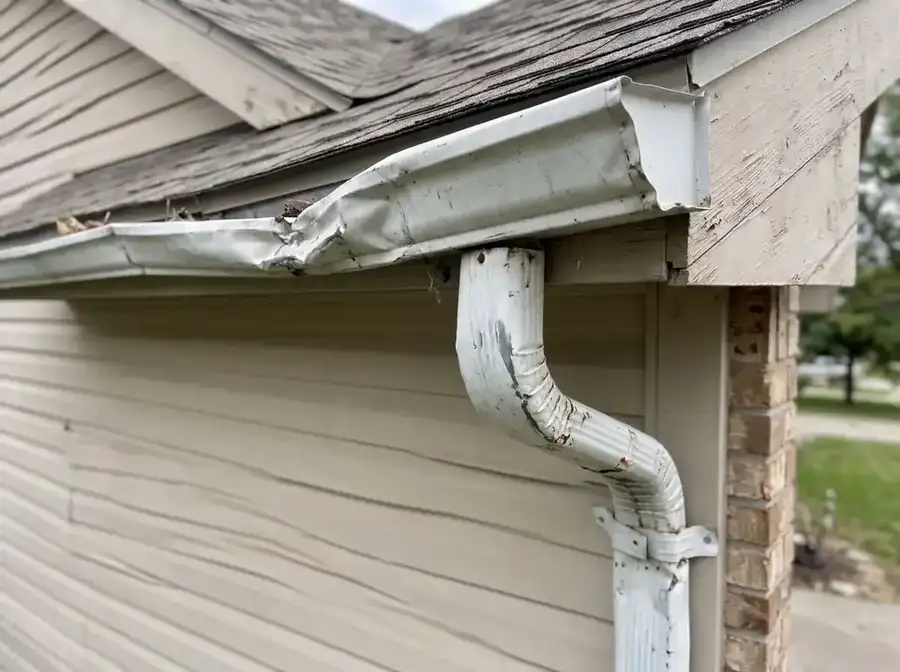
| One section creased by a limb | Repair | Replace that run |
| Sectional gutters leaking at many seams | Replace | Seams keep failing |
| Fascia rotten along most of the house | Replace | Gutter must come off anyway |
| Gutters undersized for the roof | Replace or add outlets | More capacity needed |
| Steel gutters rusting through | Replace | Rust spreads |
The guide to repair or replace works through the decision in more detail.
What a repair visit should cover
A good repair visit is more than a tube of sealant. The contractor should clean the area, find the actual cause, fix it with proper parts, and run water through the system afterwards. Ask them to point out anything else they saw while up there, such as a loose hanger, a soft spot in the fascia or a downspout that dumps at the wall, and to price those separately so you can choose.
After a storm
After a big storm, start with safety. Stay clear of downed power lines and call Duke Energy or 911 if a line is down. Photograph the damage before anything is moved, and call your insurer before agreeing to work. North Carolina's Attorney General warns that some contractors follow storms looking for quick deposits: get a written estimate, avoid paying the full amount up front, and know that a contract signed at your home after a salesperson came to you can usually be cancelled within three days.
Repairs by house type
| House | Common repairs |
|---|---|
| 1920s bungalow | Rotten fascia and rafter tails; old steel or half-round joints |
| 1960s ranch | Spikes backing out; corner leaks; downspouts at the wall |
| 2000s two-story | Aging builder sealant; valley overflow; loose outlets |
| Lake house | Storm damage; tall runs pulling loose |
| Townhome building | Shared runs; downspouts across walks |
Small repairs you can do yourself
On a one-story house, some repairs are within reach of a careful homeowner: reattaching a downspout, replacing a crushed bottom section, adding an extension, or clearing a blocked outlet. Resealing a corner takes clean, dry metal and the right sealant. Anything on the second story, on a steep roof, near the service drop or involving rotten wood is better left to a contractor.