
On this page
Why do gutters sag in Charlotte?
Queen City Gutter Co connects callers with independent local gutter contractors, who give the estimates and do the work. Many gutters on Charlotte's postwar ranches and older homes were hung on long spikes through the gutter into the fascia. Over years of heat and cold the spikes work loose. Add a trough full of wet willow oak leaves and pine needles, which is heavy, and the run starts to droop. Ice storms, such as the one in December 2002 that left more than 1.3 million people without power, add weight quickly. Once a gutter dips, water collects at the low point and makes it heavier still.
| Cause | Sign | Fix |
|---|---|---|
| Spikes backing out | Spike heads standing proud | Replace with screw-in hangers |
| Hangers too far apart | Gentle sag between hangers | Add hangers |
| Soft fascia | Hangers pulling out of wood | Replace the wood, then re-hang |
| Heavy debris | Sag where leaves collect | Clean, re-hang, consider guards |
| Ice load | Sag after a winter storm | Re-hang; check for creases |
| Lost pitch | Water standing in trough | Reset the fall |
How is a gutter re-hung?
- Clean the gutter so it is light and the trough can be checked.
- Check the wood along the run and replace soft fascia.
- Snap a line for a fall of about a quarter inch in 10 feet to the outlet.
- Remove spikes and fill the old holes.
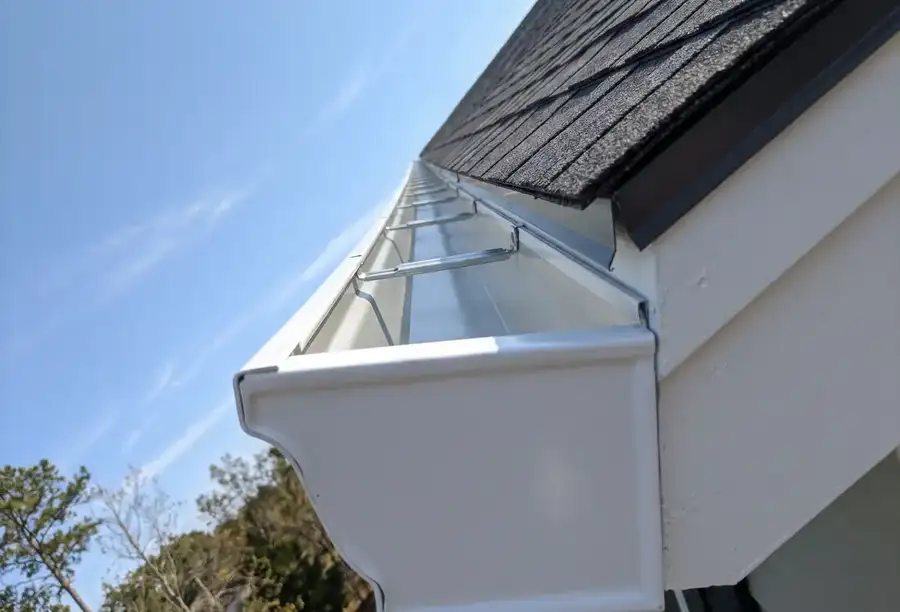
- Fit hidden hangers about every 2 feet into sound wood.
- Test with running water; nothing should stand in the trough.
When re-hanging is not enough
If the gutter itself is creased, stretched or leaking along its length, re-hanging only buys time. Sectional gutters with failing seams, rusted steel or gutters that are too small for the roof are better replaced. The fascia check is the same either way. See fascia and soffit.
Preventing sags
- Clean before summer storms and after the leaves drop. See gutter cleaning.
- Fit guards under heavy trees so leaves do not pile up.
- Ask for closer hanger spacing and 0.032 inch aluminum on long runs.
- Keep ladders off the gutter; use stand-offs.
Spikes vs hidden hangers
| Spike and ferrule | Hidden screw-in hanger | |
|---|---|---|
| Fixing | Nailed through the gutter into fascia | Clips inside the lip; screws into fascia |
| Visible | Spike heads on the front | Hidden from below |
| Holding | Works loose over years | Holds well in sound wood |
| Spacing | Often 3 feet or more | About every 2 feet |
Many Charlotte ranches built from the 1950s to the 1980s still have spikes. Replacing them with screw-in hangers is the standard fix.
Sagging on newer homes
Even newer houses can sag where hangers were set too far apart or missed solid wood, or where a valley dumps heavy water and debris onto one stretch. The fix is the same: more hangers into sound backing and the pitch reset.
What sagging costs if left
Water stands at the low point, overflows at the foundation, and soaks the fascia. The gutter gets heavier, pulls more hangers and eventually tears loose, sometimes taking fascia with it. Re-hanging early is a small job compared with replacing gutter and wood later.
Questions to ask about re-hanging
- What hangers will you use, and at what spacing?
- Is the fascia sound along the whole run?
- How will you set the pitch?
- Will you fill the old spike holes?
- Will you test with water afterwards?
On many Charlotte ranches, re-hanging the whole house at once costs little more than one run, since the crew and ladders are already there.
Sagging at valleys and corners
Sags often start where water and debris arrive fastest: below valleys and near inside corners. Leaves from the valley pile up at that spot, water stands, and the weight pulls hangers loose. Extra hangers there, a splash guard and an outlet nearby stop it recurring.
Sagging on older houses
On early-1900s houses, sagging is often a sign of rafter tails or fascia that have softened after decades of water. On these houses the re-hang starts with carpentry, and on period homes the new wood should match the original profile.
A simple check
Stand at one end of a run and sight along the bottom edge of the gutter against the roofline. It should fall steadily toward the outlet. A dip, a hump or a run that falls the wrong way needs re-hanging.