
On this page
- Why size matters in Charlotte
- When does a house need 6-inch?
- 5-inch or 6-inch at a glance
- Downspouts matter as much as the gutter
- Options before you upsize
- Mixing sizes
- Which Charlotte houses most often need 6-inch?
- What a 6-inch installation should include
- Downspout discharge with bigger gutters
- Converting an existing house
Why size matters in Charlotte
Queen City Gutter Co connects callers with independent local gutter contractors, who give the estimates and do the work. Charlotte's climate record shows about 43.6 inches of precipitation a year, with the wettest months in summer. A yearly total does not size a gutter; the heaviest few minutes of a thunderstorm do. When an inch or more falls in an hour, a big roof plane sends a lot of water to the eave at once. If the gutter or its outlets cannot take it, water sheets over the front and lands at the foundation.
When does a house need 6-inch?
| Roof feature | Why it matters | Usual answer |
|---|---|---|
| Large two-story roof planes | More area draining to each run | 6-inch or extra outlets |
| Valleys | Concentrate water onto a short stretch | 6-inch at the valley, 3x4 outlet |
| Steep pitch | Water arrives fast and can overshoot | 6-inch, sometimes splash guards |
| Long runs | More water by the time it reaches the outlet | 6-inch or outlets at both ends |
| Metal roof | Sheds water quickly | 6-inch |
| Simple one-story ranch | Modest area | 5-inch is usually fine |
5-inch or 6-inch at a glance
| 5-inch K-style | 6-inch K-style | |
|---|---|---|
| Capacity | Standard | About half again more |
| Usual downspout | 2x3 or 3x4 | 3x4 |
| Suits | Most one-story and many two-story homes | Large roofs, valleys, steep or metal roofs |
| Looks | Lighter line | Heavier, suits larger homes |
| National installed range | About $9 to $13 a foot | About $12 to $18 a foot |
The guide to 5-inch vs 6-inch gutters works through the choice in more detail.
Downspouts matter as much as the gutter
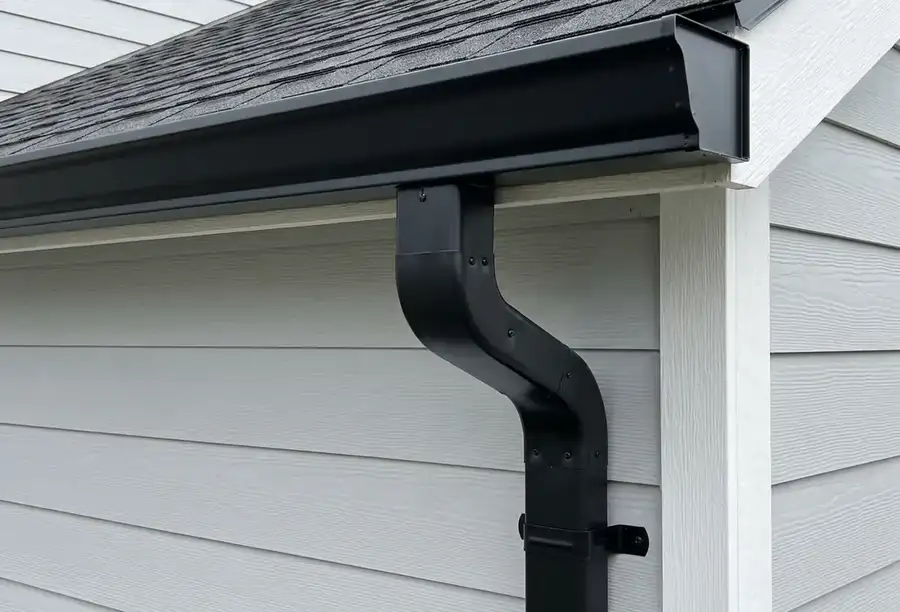
A 6-inch gutter emptying into a 2x3 downspout is held back by the outlet. Most 6-inch systems use 3x4 inch downspouts, which carry far more water and are harder to block with willow oak leaves and pine needles. Where the trough fills fastest, below a valley or at the low end of a long run, an extra outlet can matter more than the size of the gutter. See downspouts.
Options before you upsize
- Clean the outlets and see whether the overflow stops.
- Add a 3x4 outlet near the valley or the overflowing stretch.
- Fit a splash guard at the inside corner below a valley.
- Check the pitch. A run that has sagged holds water and overflows early.
- Upsize the runs that still overflow, or the whole house if most do.
Mixing sizes
Some houses use 6-inch only on the runs that need it, such as the back of a two-story house with a valley, and 5-inch elsewhere. That can work well and costs less, though the change in size shows where the runs meet. A contractor can tell you whether it suits your house.
Which Charlotte houses most often need 6-inch?
The houses that most often benefit are the two-story homes built since the 1990s in Ballantyne, Huntersville, University City, Concord and similar areas, with big hip and gable roofs and valleys over family rooms and garages. Lake houses in Cornelius, with tall water-side roofs, are another. Large rebuilds on older lots around SouthPark and Myers Park often need 6-inch too. Most brick ranches and bungalows do not.
What a 6-inch installation should include
- 6-inch seamless gutter in 0.032 inch aluminum, or copper where chosen.
- Hidden hangers sized for 6-inch.
- 3x4 downspouts, with an outlet near each valley.
- Discharge led away from the foundation, since more water now leaves each downspout.
- A water test at the valleys.
Downspout discharge with bigger gutters
A bigger gutter moves more water to each downspout. On clay soils, that water needs to go farther from the house, so 6-inch upgrades often come with longer extensions or buried lines. See downspout drainage.
Ask for any 6-inch quote to show the downspout size and count, since that is where much of the extra capacity comes from.
Converting an existing house
Going from 5-inch to 6-inch on an existing house means new gutters, not an add-on. The old runs come down, the fascia is checked, and new 6-inch runs are formed and hung. Existing downspout positions may change, and new outlets are cut where they do the most good. It is a good moment to fix discharge and add guards.