
On this page
Why downspouts matter in Charlotte
Queen City Gutter Co connects callers with independent local gutter contractors, who give the estimates and do the work. Charlotte sits in the Piedmont, where many lots have red clay soil. Clay takes in water slowly, so water dumped at the base of a wall pools, soaks the crawl space or basement wall, and cuts channels when it finally runs off. Many Charlotte homes, from 1920s bungalows to 1960s ranches, sit on crawl spaces that suffer when downspouts empty against them. Getting the water away is as important as catching it.
Sizing and count
| Downspout | Carries | Use |
|---|---|---|
| 2x3 inch | Standard | Small roofs with few trees |
| 3x4 inch | Much more, clogs less | Most houses with trees; 6-inch gutters; valleys |
| Round 3 or 4 inch | Similar by size | Half-round gutters; period houses |
As a rule of thumb, plan one downspout for every 30 to 40 feet of gutter, and another near each valley where water arrives fastest. Long runs drain best to both ends from a high point in the middle.
Where should the water go?
- Away from the house. Several feet at least, farther on clay and near crawl spaces.
- Downhill. Onto ground that falls away from the foundation.
- On your lot. Not onto a neighbor's property or across a sidewalk where it can freeze.
- Spread out. A splash block or rock bed slows water so it does not cut the clay.
- Into a drain line where the yard is flat or the house sits low.
Discharge options
| Option | Good for | Watch out for |
|---|---|---|
| Splash block | Short distance on sloping ground | Not enough on flat clay lots |
| Extension or flip-up | Longer reach without digging | Mower damage; tripping |
| Buried pipe to pop-up | Flat yards, lawns | Clogs if gutters are not kept clean |
| Pipe to daylight downhill | Sloping lots | Needs a safe outlet point |
| Rain barrel | Watering gardens | Overflows in storms; needs an outlet |
Charlotte-Mecklenburg Storm Water Services and the Mecklenburg Soil and Water Conservation District have offered rain barrels; a barrel still needs an overflow led away from the house. The guide to downspout drainage covers this in more detail.
Common downspout problems
- Crushed at the base by mowers or cars. Replace the bottom section and add a guard.
- Clogged at the elbows with leaves and acorns. Flush from the top.
- Pulling off the wall. Re-strap every 6 to 8 feet.
- Emptying against the wall. Add an extension or drain line.
See downspout repair.
Downspouts on different houses
| House | Downspout notes |
|---|---|
| Brick ranch on a crawl space | 3x4 with extensions or buried lines well away from the wall |
| Two-story with valleys | Extra 3x4 outlet near each valley |
| Bungalow with half-round | Round 3 or 4 inch, with straps that suit the period |
| Lake house on a slope | Piped or spread so it does not erode toward the water |
| Townhome | Discharge away from shared walks and parking |
Straps, elbows and outlets
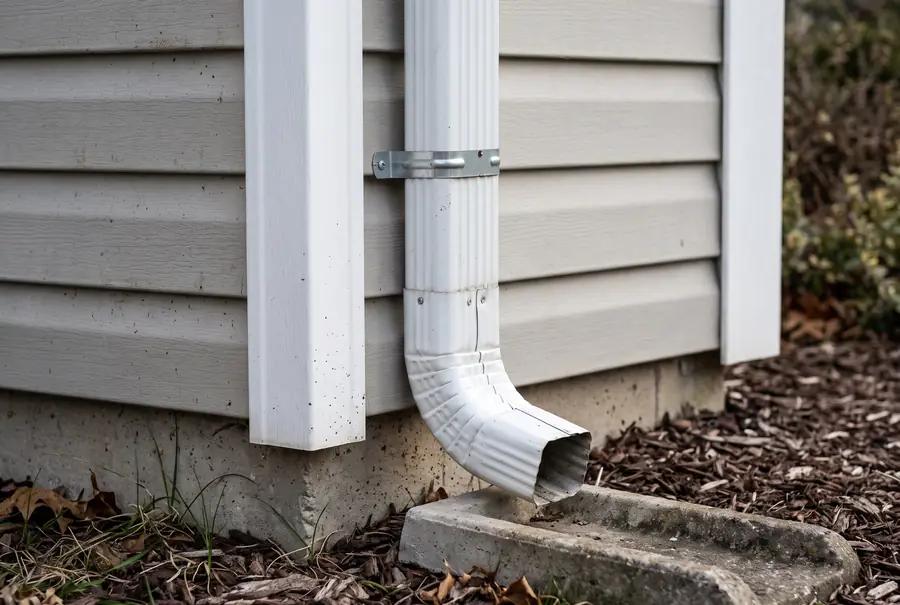
A downspout should be strapped to the wall about every 6 to 8 feet, with the straps screwed into solid backing. Elbows at the top bring it from the outlet back to the wall; elbows at the bottom turn it out onto the splash block or into the drain. Each elbow is a place for willow oak leaves and acorns to catch, so keep them to what is needed. The outlet where gutter meets downspout should be cut cleanly and sealed so it does not drip.
Rain barrels and downspouts
A rain barrel connects to a downspout through a diverter or a cut section. It stores water for the garden, but a summer storm fills it in minutes. The barrel needs an overflow, led away from the foundation just as the downspout would be, and a cover to keep mosquitoes out.
Adding downspouts to an existing system
Adding a downspout is one of the cheapest ways to improve a gutter system. The contractor cuts a new outlet in the bottom of the gutter, fits a 3x4 drop, and runs the downspout down the wall to a suitable discharge point. Where a long run drains to one corner, a new outlet in the middle halves the distance water travels. Where a valley pours in, an outlet below it stops overflow.