
On this page
- The short answer
- Why timing matters here
- Signs your gutters are due
- Doing it safely
- Where guards change the answer
- A year of gutters in Charlotte
- What a clean should leave behind
- Doing it yourself on a one-story house
- When a clean reveals a bigger problem
- Signs the schedule needs to change
- Cleaning and the rest of the house
- The bottom line
The short answer
Queen City Gutter Co connects callers with independent local gutter contractors, who give the estimates and do the work.
| House | How often | When |
|---|---|---|
| Few trees nearby | Once or twice a year | December; maybe May |
| Under willow oaks or mixed hardwoods | Twice a year | May and December |
| Under pines | Three times a year | May, August or September, December |
| With micro-mesh guards | Check and rinse once or twice | Spring and winter |
| Two-story with valleys | As above, plus after big storms | Valleys fill first |
Why timing matters here
Charlotte's wettest months are in summer, and thunderstorms drop rain fast. Gutters cleared in late spring go into storm season with open outlets. Willow oaks and other oaks drop most leaves from November into December, so a December clean catches the bulk of them. Pines drop needles all year, so pine-shaded houses benefit from a late-summer clean before the tropical season peaks.
Signs your gutters are due
- Water spilling over the front in rain.
- Plants or seedlings growing in the gutter.
- A run that has started to sag.
- Stains on the fascia or siding below.
- Water pooling at the foundation where a downspout should be carrying it away.
- Debris visible from an upstairs window.
Doing it safely
- Use a sound ladder on firm, level ground, with a helper.
- Use stand-offs so the ladder does not dent the gutter.
- Keep away from the power line that runs to the house.
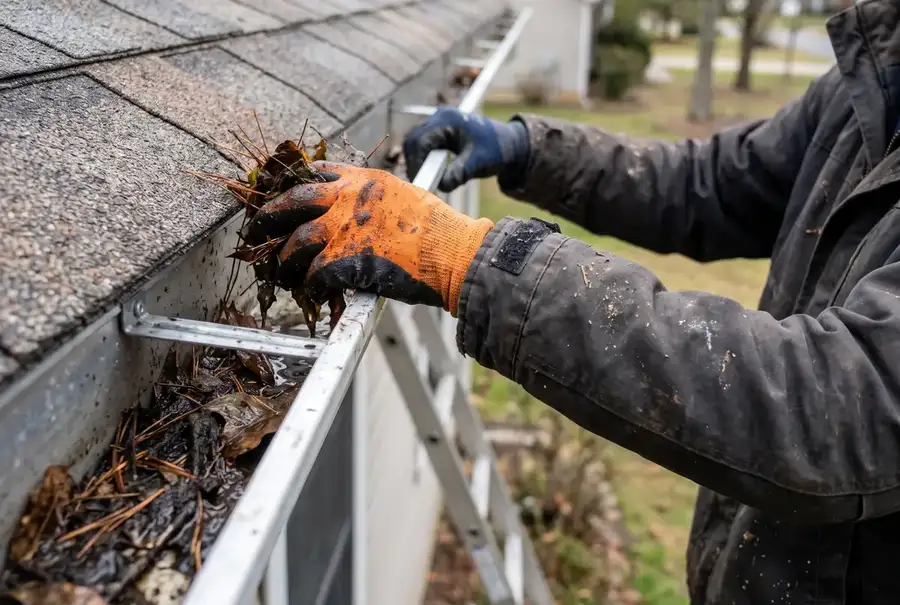
- Scoop by hand and bag the debris.
- Flush downspouts from the top.
- Do not walk steep or wet roofs.
For two-story houses, steep roofs or anything near power lines, hire a crew. See gutter cleaning.
Where guards change the answer
Under willow oaks and pines, micro-mesh guards can turn two or three cleanings into a once- or twice-yearly check and rinse. See are gutter guards worth it?.
A year of gutters in Charlotte
| Month | What is falling | What to do |
|---|---|---|
| March and April | Pine and oak pollen, catkins, maple seeds | Watch for yellow film; plan a May clean |
| May | Seeds and the last of the pollen | Spring clean; flush downspouts; rinse guards |
| June to August | Summer thunderstorms; needles | Check outlets after big storms |
| September | Peak of the tropical season | Late-summer clean under pines |
| October and November | Leaves begin; acorns and gumballs | Clear outlets if they fill early |
| December | The last oak leaves | Main clean of the year |
| January and February | Occasional ice | Check for sags and split joints after a freeze |
What a clean should leave behind
A clean is not finished when the leaves are out. Each run should be rinsed so grit does not sit in the bottom, each downspout flushed until water runs freely from the bottom, and each outlet checked. While someone is up there, they should look at the corners and end caps for leaks, the hangers for any that have pulled loose, and the fascia for soft spots. A good cleaning crew reports what it finds with photos, so you know whether a small repair is due before it becomes a bigger one.
Doing it yourself on a one-story house
Many Charlotte homeowners clean their own one-story gutters. A few habits make it safer and more effective:
- Work from the ladder, moving it often, rather than reaching sideways.
- Start at the outlet and work away from it, so the first thing cleared is the drain.
- Use a gutter scoop and a bucket hung from the ladder.
- Flush with a hose at the high end and watch the downspout.
- Wear gloves; debris can hide sharp screws and broken hangers.
Leave two-story work, steep roofs, wet roofs and anything near the service drop to a crew.
When a clean reveals a bigger problem
If water still stands in the trough after cleaning, the gutter has lost its pitch. If water drips at corners, the sealant has failed. If the gutter flexes when you touch it, the hangers or the fascia have let go. Those are repairs, not cleaning. See gutter repair.
Signs the schedule needs to change
Trees grow, and a schedule that worked five years ago may not now. Move to more frequent cleaning, or consider guards, if you notice:
- Overflow before the planned clean comes round.
- Seedlings sprouting in the gutter in summer.
- More needles or leaves on the roof itself.
- A new tree reaching the roofline.
- Water standing in the trough a day after rain.
Move to less frequent cleaning if a big tree near the house has come down or been removed, or if guards have gone on. A crew that cleans the gutters each year can tell you how full they were, which is the best guide to whether the timing is right.
Cleaning and the rest of the house
Cleaning time is a good moment to look at the roof edge, the shingles near the gutter, the soffit vents and the paint on the fascia. Small problems found then, such as a lifted shingle or a soft spot in the trim, are cheaper to fix than after another season of water.
If you are not sure how full your gutters get, look from an upstairs window or take a phone photo from a ladder at the low end of each run in late November. That single check tells you more than any rule of thumb.
The bottom line
Clean before summer storms and after the leaves drop. Add a third clean under pines. Check after big storms.